
Introduction
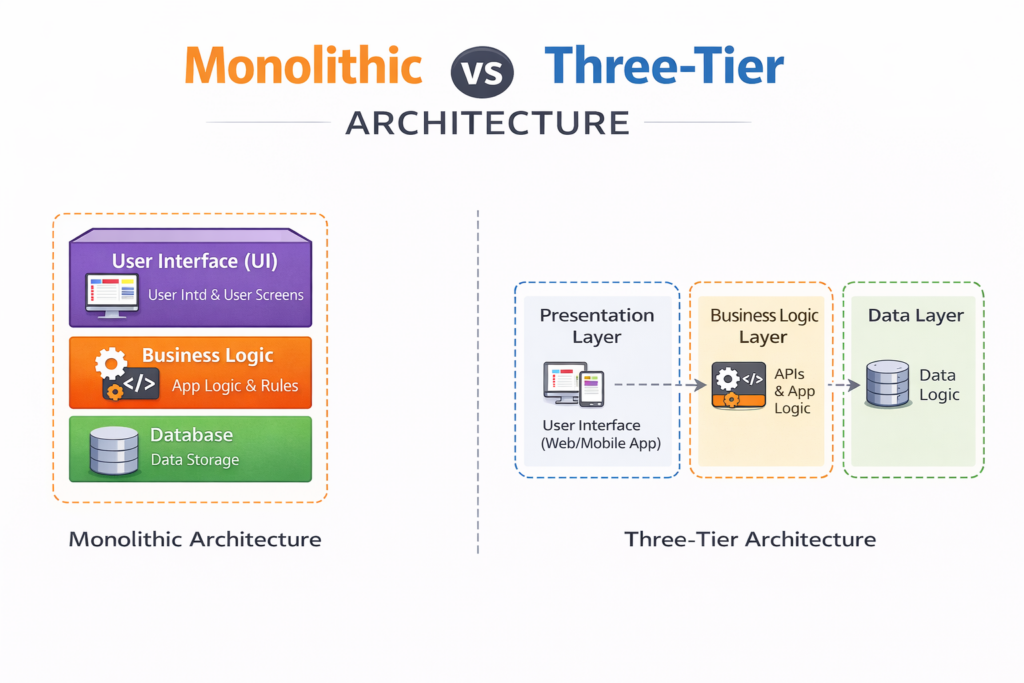
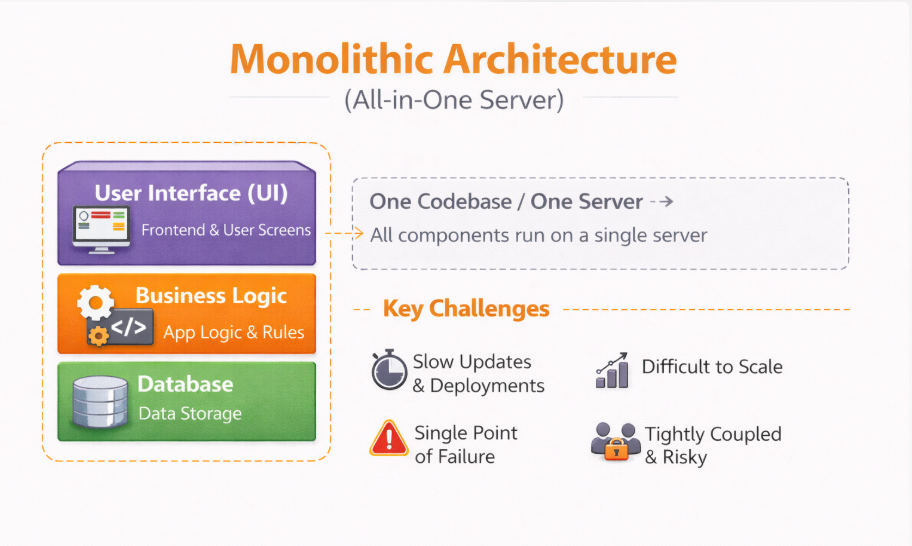
In the early days of software development, we used monolithic architecture — one big application where everything was combined: user interface, logic, and database.A monolithic application means everything runs in one single structure or codebase.
All parts — user interface, business logic, and database — are tightly connected.
What Made Monolithic Attractive at First
When we first started building our application, choosing a monolithic architecture felt like the most natural decision. At an early stage, we don’t think about scaling millions of users or handling complex workflows — we just want to get the product out quickly. And that’s exactly where monolithic architecture shines.
Back then, our priorities were simple:
1. Speed of Development
A monolith allowed us to build fast.
All the components — UI, business logic, and database access — lived in one codebase. No splitting modules, no dealing with separate deployments, no worrying about inter-service communication. Just write the code and push.
For a small team with limited time, this was a blessing.
2. Easier to Understand for Everyone
At the beginning, the entire application fit inside one mental model.
New developers could clone one repository, run the project, and immediately understand how everything was connected. There were fewer moving parts, fewer layers, and far less architectural complexity.
It made onboarding quick and painless.
3. Simple Deployment Pipeline
Deployment was straightforward — build once, deploy once.
No multiple services, no dependency management between layers, no container orchestration. We didn’t need DevOps expertise or a complex CI/CD system. A monolith kept operations lightweight and manageable.
That’s when the three-tier architecture model became the standard — helping us build faster, safer, and more scalable systems, especially in cloud platforms like Microsoft Azure.
The Problems with Monolithic architecture
At first, the monolithic system worked well. But as our project grew, we started running into real issues.
1. Everything Became Slower
Even small changes took a long time because the whole application had to be rebuilt and deployed together.
2. Hard to Scale
If one feature needed more power, we still had to scale the entire app — which wasted resources.
3. One Bug Broke Everything
A small bug in one part of the code could crash the whole system since everything was tightly connected.
4. Difficult to Add New Features
Adding new features became risky. One change could easily affect something else without us noticing.
5. Team Productivity Dropped
As more developers joined, everyone worked in the same big codebase, causing conflicts and slowdowns.
The Turning Point
The real turning point came when our system failed during a high-traffic period.
A small change caused unexpected errors, and fixing it took hours because everything was connected in one big block of code.
That was when we realized the monolithic setup would not support our growth.
Why We Chose Three-Tier Architecture
We chose the three-tier architecture because it separates the app into clear layers:
- Presentation layer – handles the UI
- Business layer – handles core logic
- Data layer – handles database work
This structure made the system easier to manage, scale, and update.
It also reduced the risk of one small issue affecting the entire application.
What is Three-Tier Architecture?
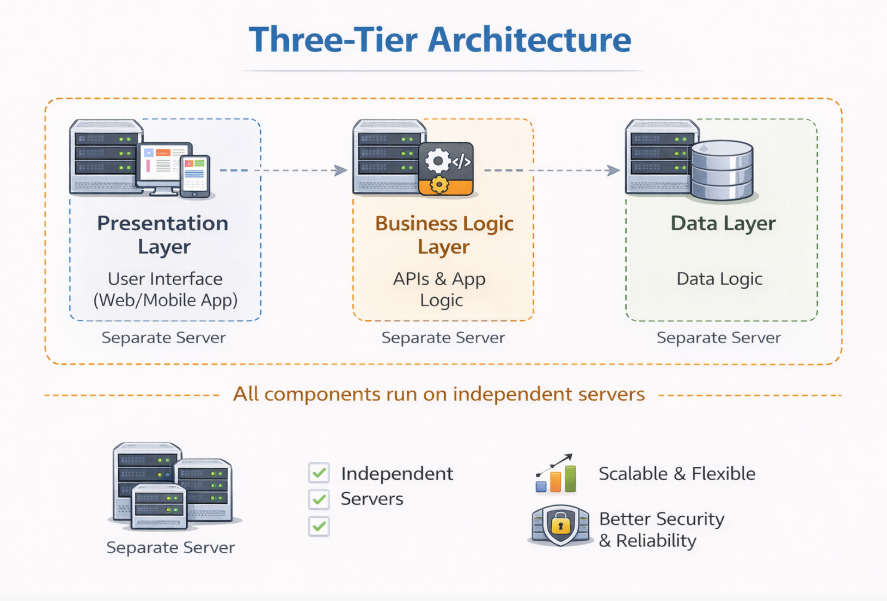
Three-tier architecture divides an application into three separate layers:
1️⃣ Presentation Tier (Front-End):
The user-facing layer — website or mobile app interface.
2️⃣ Application Tier (Logic Layer):
The brain of the app — processes requests, APIs, and business logic.
3️⃣ Database Tier (Data Layer):
The layer that stores and manages data securely.
Each layer can work independently, making the system more organized and reliable.
Challenges During Migration
Moving from monolithic to three tiers was not easy.
We faced challenges like:
- Breaking the old code into separate layers
- Managing multiple deployments instead of one
- Training the team to follow the new structure
- Handling temporary issues during the transition
But step by step, the system became more stable.
Results After Migration
After completing the migration, we saw several improvements:
- Faster and safer deployments
- Easier to add new features
- Better performance during high traffic
- Individual layers could be scaled separately
- Overall, the system became more stable and developer-friendly
Three Tier Example in Microsoft Azure
Here’s a simple Azure setup using three-tier architecture:
- Frontend: Azure App Service hosting the web application.
- Backend: Azure Kubernetes Service (AKS) or App Service for APIs and logic.
- Database: Azure SQL Database or Cosmos DB for data storage.
All layers connect using Private Endpoints and Virtual Networks (VNets) for security.
💡 This design improves performance, security, and scalability — ideal for any enterprise-grade app.
Best Practices for Three-Tier Architecture
✔️ Use NSGs (Network Security Groups) to restrict access between layers.
✔️ Keep credentials in Azure Key Vault.
✔️ Use Application Gateway or Azure Front Door for traffic management.
✔️ Enable Autoscaling for better performance during high load.
Final Thought
We moved from Monolithic to Three-Tier Architecture to make systems:
- More modular (easy to manage)
- More secure (isolated layers)
- More scalable (each tier can grow independently)
This architecture is now the foundation of all modern cloud applications in Azure and DevOps.
Summary
| Concept | Monolithic Architecture | Three-Tier Architecture |
|---|---|---|
| Structure | Single block | Divided into 3 layers |
| Scalability | Hard | Easy and flexible |
| Security | Limited | Layer-based security |
| Updates | Risky and slow | Safe and independent |
Conclusion
In simple words —
👉 Monolithic = One big box (hard to change)
👉 Three-Tier = Three smart boxes (easy to grow and secure)
That’s why today, in every cloud and DevOps setup, we prefer three-tier architecture for its stability, flexibility, and speed.


