Introduction
In today’s fast-moving software world, CI/CD (Continuous Integration and Continuous Deployment) is no longer optional. Teams are expected to release features faster, fix bugs quickly, and deploy reliably — without breaking production.
In the early days, deployments were manual, slow, and risky. But as applications grew more complex and cloud adoption increased, teams needed better automation. That’s where modern CI/CD tools came in.
By 2026, CI/CD tools are not just about running builds — they focus on developer experience, speed, security, and cloud-native deployments.
Why Choosing the Right CI/CD Tool Matters
A good CI/CD tool helps teams:
- Automate build, test, and deployment
- Reduce human errors
- Release faster and more frequently
- Improve collaboration between Dev and Ops
- Maintain consistent and repeatable deployments
The wrong tool, however, can slow teams down and increase operational burden.
What Modern CI/CD Tools Look Like in 2026
CI/CD tools today are expected to be:
- YAML-based and version-controlled
- Cloud-native and scalable
- Easy to integrate with Git platforms
- Secure by default (DevSecOps)
- Simple to maintain with minimal overhead
With this in mind, let’s look at the top CI/CD tools used most in 2026.
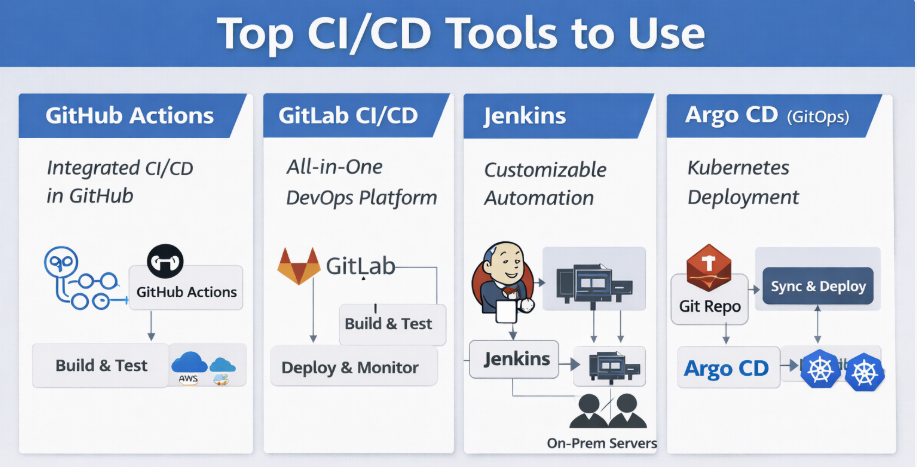
Top CI/CD tools used most in 2026
1. GitHub Actions
GitHub Actions is one of the most popular CI/CD tools today and continues to dominate in 2026.
Why Teams Use GitHub Actions
- Built directly into GitHub
- No separate CI server to manage
- Simple YAML-based workflows
- Huge marketplace of reusable actions
- Strong integration with pull requests and reviews
For teams already using GitHub, GitHub Actions feels like a natural choice. You push code, and pipelines run automatically.
Best Use Case
- Small to large teams
- Open-source projects
- Cloud-native applications
- WordPress, APIs, containers, and microservices
2. GitLab CI/CD
GitLab CI/CD offers a complete DevOps platform — from code to production.
Why Teams Choose GitLab CI/CD
- CI/CD built directly into GitLab
- Single tool for repo, pipeline, security, and deployments
- Strong Kubernetes and cloud support
- Easy pipeline visibility
Teams that want everything in one place often prefer GitLab CI/CD over managing multiple tools.
Best Use Case
- End-to-end DevOps workflows
- Teams wanting a single DevOps platform
- Kubernetes-heavy projects
3. Jenkins
Jenkins is one of the oldest and most widely known CI/CD tools — and it’s still used in 2026.
Why Jenkins Is Still Used
- Completely open-source
- Extremely flexible
- Thousands of plugins
- Works well in on-prem and legacy systems
However, Jenkins requires significant maintenance, including server management, plugin updates, and security patching.
Best Use Case
- Legacy systems
- On-premise environments
- Highly customized pipelines
- Enterprises needing full control
4. Argo CD (GitOps CI/CD)
Argo CD represents the GitOps approach, which is becoming very popular by 2026.
Why Argo CD Is Growing
- Git is the single source of truth
- Designed specifically for Kubernetes
- Declarative deployments
- Better visibility and rollback
Argo CD focuses more on continuous deployment, working alongside CI tools like GitHub Actions or GitLab CI.
5. Azure DevOps Pipelines
Azure DevOps Pipelines is a strong choice for teams working in the Microsoft ecosystem.
Why Teams Use Azure DevOps
- Deep integration with Azure services
- Supports YAML and classic pipelines
- Enterprise-ready security and compliance
- Works well with .NET, Java, and cloud apps
It’s commonly used in large organizations that already rely on Microsoft tools.
Best Use Case
- Azure-based infrastructure
- Enterprise applications
- Microsoft-centric teams
6. CircleCI
CircleCI is known for speed and performance, especially in cloud-native setups.
Why CircleCI Is Popular
- Fast execution
- Built-in caching and parallelism
- Strong SaaS offering
- Easy GitHub and GitLab integration
Startups and SaaS companies often choose CircleCI for rapid iteration.
Best Use Case
- High-speed CI pipelines
- Startups and product teams
- Containerized applications
Best Use Case
- Kubernetes deployments
- GitOps workflows
- Platform engineering teams
Most Used CI/CD Tools Today (Quick Summary)
| Tool | Popularity | Best For |
|---|---|---|
| GitHub Actions | ⭐⭐⭐⭐⭐ | GitHub-based projects |
| GitLab CI/CD | ⭐⭐⭐⭐ | All-in-one DevOps |
| Jenkins | ⭐⭐⭐⭐ | Legacy & on-prem |
| Azure DevOps | ⭐⭐⭐ | Microsoft ecosystem |
| CircleCI | ⭐⭐⭐ | Fast cloud CI |
| Argo CD | ⭐⭐⭐⭐ | Kubernetes GitOps |
Which CI/CD Tool Should You Choose?
There is no single best tool for everyone.
- If your code is on GitHub → GitHub Actions
- If you want one DevOps platform → GitLab CI/CD
- If you need full control → Jenkins
- If you use Azure heavily → Azure DevOps
- If you run Kubernetes → Argo CD
The best tool is the one that fits your workflow, team size, and infrastructure.
Modern CI/CD pipelines work best with scalable application architectures.
Final Thought
In 2026, CI/CD is not just about automation — it’s about developer productivity, reliability, and speed.
Modern teams prefer tools that:
- Require less maintenance
- Integrate tightly with Git
- Scale automatically
- Support cloud and Kubernetes
That’s why platforms like GitHub Actions and GitLab CI/CD are growing rapidly, while Jenkins continues to serve specific enterprise and legacy needs.